AI Translated from Chinese
Problem
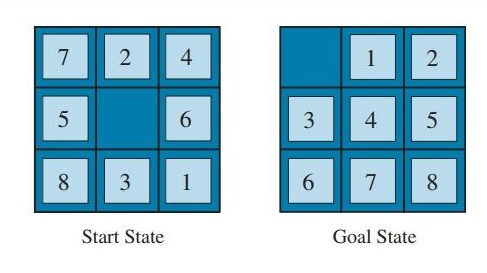
Familiar with Klotski? Or the Number Slide game that came with Win7? The 8-Puzzle problem is derived from this game:
Given 1~8 numbered square tiles arranged in a 3×3 grid, with one cell empty. Each move allows you to slide a tile adjacent to the empty space into the empty cell. Given an initial state and target state (empty space represented by 0), find the minimum number of moves, or output
-1if the target is unreachable.
Analysis
This is also BFS for shortest path. But we need to check for duplicates — avoid visiting the same state multiple times, otherwise it would waste significant time and space.
For this problem, Hash is a feasible and efficient method. Simply put, we design a function h(x) that maps any node x to an integer in the range [0, M-1], where M is chosen based on available memory. In the ideal case, we only need an array of size M to check for duplicates. However, sometimes different nodes may have the same hash value, so we need to organize states with the same hash value into a linked list.
Code
From the “Algorithm Competition Introduction Classic”
There are some worth-learning tips, such as defining a “state” type, using two arrays to simulate a singly-linked list, and using “references” to simplify code.
eight_nums.cpp
#include <iostream>
#include <cstring>
using namespace std;

typedef int State[9];  // Define "state" type
const int MAXSTATE = 1e6;
State st[MAXSTATE], goal;  // State array. All states are stored here
int dist[MAXSTATE];  // Distance array

const int dx[] = {-1, 1, 0, 0};
const int dy[] = {0, 0, -1, 1};

const int MAX_HASH_SIZE = 1e6 + 3;
int head[MAX_HASH_SIZE], next_[MAXSTATE];  // Simulate singly-linked list

void init_lookup_table() {  // Initialize lookup table
    memset(head, 0, sizeof(head));
}

int myhash(State &s) {  // Hash function
    int v = 0;
    for (int i = 0; i < 9; i++) v = v * 10 + s[i];  // Combine 9 digits into a 9-digit number
    return v % MAX_HASH_SIZE;  // Ensure hash function returns non-negative integer within hash table size
}

int try_to_insert(int s) {
    int h = myhash(st[s]);
    int u = head[h];  // Start searching from the list head
    while (u) {
        if (memcmp(st[u], st[s], sizeof(st[s])) == 0) return 0;  // Found, insertion failed
        u = next_[u];  // Continue along the linked list
    }
    next_[s] = head[h];  // Insert into linked list
    head[h] = s;
    return 1;
}

int bfs() {
    // BFS, returns index of target state in st array
    init_lookup_table();  // Initialize lookup table
    int front = 1, rear = 2;  // Don't use index 0, as 0 means "doesn't exist"
    while (front < rear) {
        State &s = st[front];  // Use "reference" to simplify code
        if (memcmp(goal, s, sizeof(s)) == 0) return front;  // Found target state, return success
        int z;
        for (z = 0; z < 9; z++) if (!s[z]) break;  // Find position of "0"
        int x = z/3, y = z%3;  // Get row and column numbers (0~2)
        for (int d = 0; d < 4; d++) {
            int newx = x + dx[d];
            int newy = y + dy[d];
            int newz = newx * 3 + newy;
            if (newx >= 0 && newx < 3 && newy >= 0 && newy < 3) {  // If move is valid
                State &t = st[rear];
                memcpy(&t, &s, sizeof(s));  // Expand new node
                t[newz] = s[z];
                t[z] = s[newz];
                dist[rear] = dist[front] + 1;  // Update distance of new node
                if (try_to_insert(rear)) rear++;  // If successfully inserted into lookup table, update rear pointer
            }
        }
        front++;  // After expanding, update front pointer
    }
    return 0;  // Failed
}

int main() {
#ifdef LOCAL
    freopen("eight_nums.in", "r", stdin);
    freopen("eight_nums_.out", "w", stdout);
#endif
    ios::sync_with_stdio(false);
    cin.tie(0);
    cout.tie(0);
    for (int i = 0; i < 9; i++) cin >> st[1][i];  // Initial state
    for (int i = 0; i < 9; i++) cin >> goal[i];  // Target state
    int ans = bfs();  // Returns index of target state
    if (ans > 0) cout << dist[ans] << endl;
    else cout << -1 << endl;
    return 0;
}
Thoughts
Besides Hash, there are many other methods, such as encoding, A*, STL set (low efficiency, only as a “stepping stone”), etc. I’ll try them when I learn more.
References
- Liu Rujia “Algorithm Competition Introduction Classic (2nd Edition)”